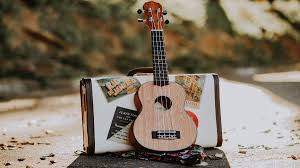
The Ukulele History is one of the most attractive yet familiar instruments in the world. It has been a welcome addition to music in all cultures and forms because of its warm and cheerful sound and its compact nature. What is more popular is a mystery behind its popularity. Knowing the history of the ukulele, one can determine how a small Hawaiian-decent stringed instrument rose to fame around the globe.Ukulele History
The Origins of the Ukulele
The history of ukulele dates back to the end of 19 th century. In the 1870s, the machete, a small instruments, were introduced in Hawaii as Portuguese emigrants, the Madeirans and Azoreans, bestowed it upon the Hawaiian people. Soon Hawaiians adopted this instrument, transforming and modifying it into the modern-day ukulele.
Even the name ukulele is translated into Hawaiian as to jump flea, ” which is a term that the fingers move in defeat of the strings really fast by a musician. The Hawaiian musicians enhanced its design by simplifying it and making it smaller and more comfortable to carry around, besides simplifying the tuning to enable them to get that bright and happy sound.
Royalties and Hawaiian Favoriteness.
The prestige and visibility of Ukulele were outcomes of a ruler, King David Kalakaua, Merrie Monarch. As a person who greatly adored the Hawaiian arts and culture, he influenced the players to perform the royal events and concerts with the help of the ukulele. Under his rule, the instrument gained importance in the traditional Hawaiian music and dance.
The ukulele’s history was confirmed in the Hawaiian culture by the beginning of the 20th century. It was also received as such due to the sweet sound that aided in keeping the Hawaiian identity pumped, particularly during the acclaimed times of political and social music changes.
Crossing the Pacific with the Ukulele.
The first half of the 20th century became the next step in the history of the ukulele. Hawaiian music and performances on the ukulele were first exposed on the mainland of the United States in 1915 and featured by the Panama-Pacific International Exposition held in San Francisco. The colorful beats and exoticism were love song to the American audience and triggered a craze in the country.
Soon, manufacturers in the U.S. started to make cheap ukuleles and hence the instrument became accessible to regularly used households. It was also particularly popular among novice musicians and those who were young.
The Golden Age of the Ukulele
The ukulele had become firmly ingrained in the American popular culture by the 1920s and the 1930s. Jazz, vaudeville, and recording artists came to incorporate the use of the instrument in their music. The history of the ukulele that was experienced in this era demonstrates that it underwent the process of being regarded as an item of carefree enjoyment and boyish vigor.
Books on ukulele teaching were also popularly written and it was an order of the day to see college students at a social gathering playing along on their ukulele. That instrument was not a mere novelty the instrument was a cultural phenomenon.
Decline and Revival
The popularity of the ukulele went down like many other trends. In the mid-20th century, guitar started ruling the musical world and ukulele got the label of a toy instrument instead of an oft-them.
Nonetheless, this is not the end of the history of ukulele. The ukulele has re-emerged in an incredible way beginning in the 1990s and at the beginning of the 2000s. The most elastic view of the beauty of the instrument was reminded to the world in the form of Hawaiian musicians like Israel Kamakawiwoʻoles (IZ) whose version of the song Somewhere Over the Rainbow became iconic. Ukulele History
Soon, indie artists, YouTubers, and mainstream performers also started using the ukulele in their music. It was affordable and easy to pick up, making it attractive to a fresh generation of musicians.
The Ukulele Today
Ukulele is widely popular the world over today. It continues to motivate imagination, be it in classrooms or concert halls. This variety is in the way that it is combined with jazz, pop, folk and even rock.
The history of the ukulele speaks of the culture of cultural interaction and adaptation and survival. What was originally seen as a modest Portuguese tool would end up forming part of the Hawaiian culture and, later on, a symbol of good mood and minimalism on a global scale.
Final Thoughts
The study of ukulele history not only provides us with the facts about a musical instrument but also relates us to the history of individuals, cultures, creativity in different parts of the world. Your strumming to play to a crowd of people and playing a few notes remind of your amazing journey even now.Ukulele History
About the Author